

ITI vs Polytechnic: Which Course Is Better in 2026?
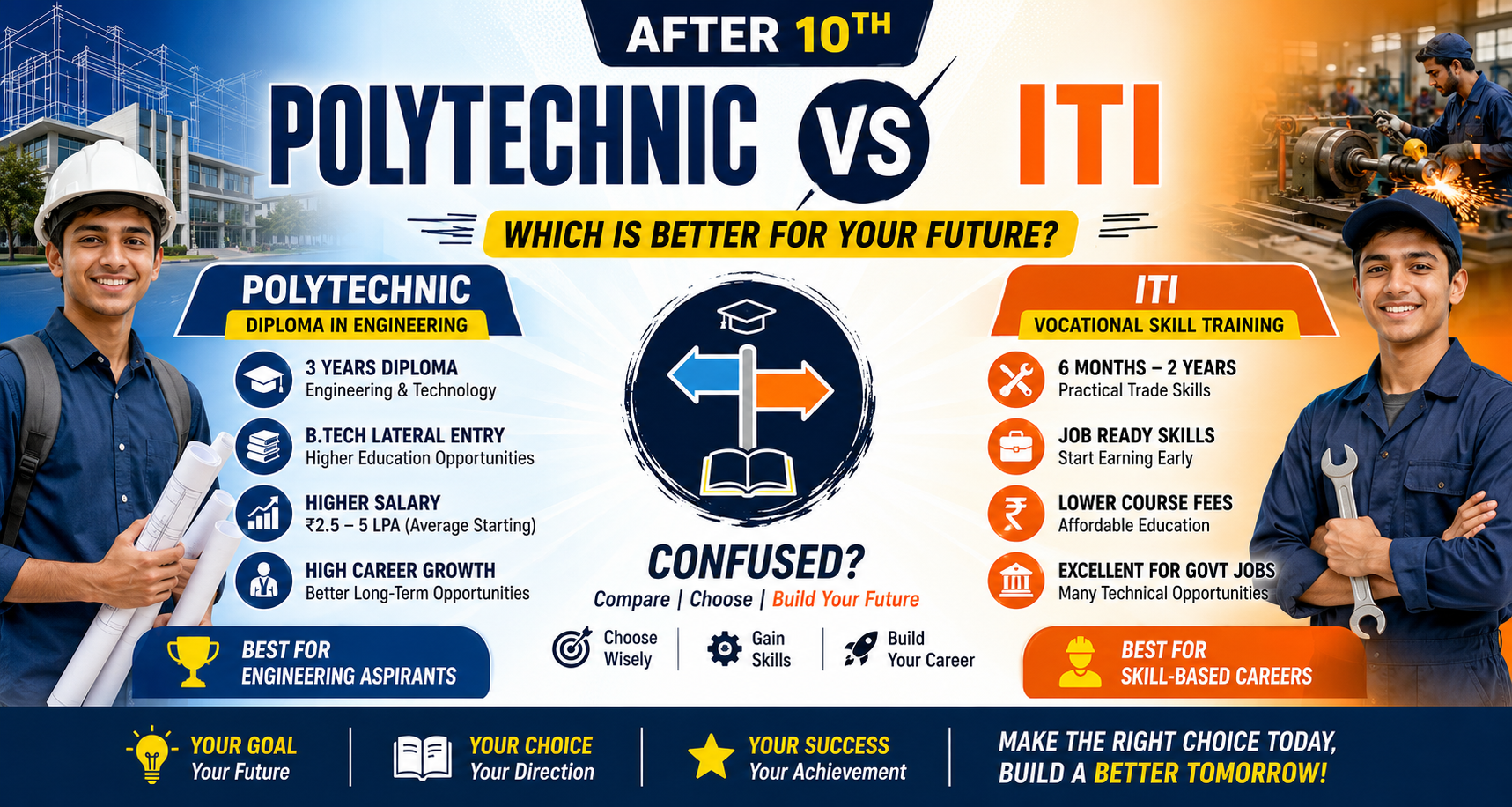
Polytechnic is the better choice if you want to become an engineer, pursue B.Tech through lateral entry, earn a higher salary, and enjoy long-term career growth. ITI is ideal if you want practical skills, quicker employment, and lower education costs. The right option depends on your career goals, interests, and future plans.
Polytechnic vs ITI After 10th: Which Should You Choose?
After completing Class 10, many students face a common question: Should I choose Polytechnic or ITI? Both are excellent technical education options, but they lead to different career paths. A Polytechnic Diploma focuses on engineering and technology, while an Industrial Training Institute (ITI) provides vocational training in specific technical trades.
If your dream is to become an engineer, work in large industries, or pursue higher education like B.Tech, Polytechnic is generally the better choice. On the other hand, if you want to gain practical skills and start earning quickly, ITI can be the right option. Before deciding, compare both courses based on eligibility, duration, fees, salary, career opportunities, and future scope.
Polytechnic vs ITI: Quick Comparison
| Feature | Polytechnic Diploma | ITI |
|---|---|---|
| Course Type | Diploma in Engineering | Vocational Skill Training |
| Qualification | Diploma | Certificate |
| Duration | 3 Years | 6 Months–2 Years |
| Eligibility | Class 10 Pass | Class 8 or 10 Pass |
| Admission | Merit/Entrance | Merit-Based |
| Focus | Engineering & Technology | Practical Trade Skills |
| Higher Education | B.Tech Lateral Entry | Limited |
| Starting Salary | ₹2.5–5 LPA | ₹1.8–3.5 LPA |
| Career Growth | High | Moderate |
| Best For | Engineering Aspirants | Skill-Based Careers |
Expert Tip: If you want long-term career growth and engineering opportunities, choose Polytechnic. If your goal is to become job-ready in less time, ITI is a great option.
What Is a Polytechnic Diploma?
A Polytechnic Diploma is a three-year technical program that prepares students for careers in engineering, manufacturing, construction, IT, electronics, and industrial sectors. The curriculum combines classroom learning with practical training, laboratory sessions, workshops, industrial visits, and live projects.
Polytechnic colleges are approved by AICTE (All India Council for Technical Education) and state technical education boards. After completing the diploma, students can either join the workforce or take lateral entry admission directly into the second year of B.Tech, making it an excellent choice for those planning a long-term engineering career.
Popular Polytechnic Branches
- Civil Engineering
- Mechanical Engineering
- Electrical Engineering
- Computer Science Engineering
- Electronics & Communication Engineering
- Information Technology
- Artificial Intelligence & Machine Learning
- Automobile Engineering
Polytechnic graduates are employed in construction companies, IT firms, manufacturing industries, railways, public sector undertakings (PSUs), infrastructure projects, and government departments.
What Is ITI?
An Industrial Training Institute (ITI) provides vocational education that focuses on practical skills required for specific technical trades. ITIs operate under the Directorate General of Training (DGT) and offer courses affiliated with NCVT or SCVT.
Unlike Polytechnic, ITI emphasizes hands-on training rather than engineering theory. Students learn industry-specific skills that help them secure employment soon after completing the course. Many graduates also complete apprenticeships under the National Apprenticeship Promotion Scheme (NAPS) to gain practical work experience before joining full-time jobs.
Popular ITI Trades
- Electrician
- Fitter
- Welder
- Turner
- Diesel Mechanic
- COPA (Computer Operator & Programming Assistant)
- Plumber
- Wireman
- Refrigeration & Air Conditioning Technician
- Motor Mechanic Vehicle
Polytechnic vs ITI: Key Differences
Although both courses belong to technical education, they differ in their curriculum, learning approach, and career outcomes.
| Feature | Polytechnic | ITI |
|---|---|---|
| Education Level | Diploma | Certificate |
| Learning Style | Theory + Practical | Mostly Practical |
| Career Goal | Engineer | Skilled Technician |
| Course Depth | Advanced Technical Knowledge | Trade-Based Skills |
| Higher Education | Excellent | Limited |
| Long-Term Salary Growth | Higher | Moderate |
Choose Polytechnic If You:
- Want to become an engineer.
- Plan to pursue B.Tech after diploma.
- Prefer Mathematics, Science, and technical subjects.
- Aim for better long-term salary growth.
- Want leadership or supervisory roles in engineering industries.
Choose ITI If You:
- Want to start working quickly.
- Prefer practical, hands-on learning.
- Want a shorter and more affordable course.
- Enjoy working with machines, tools, and equipment.
- Plan to prepare for technical government jobs.
Eligibility Criteria
Understanding the eligibility requirements can help you choose the right course after Class 10.
| Criteria | Polytechnic | ITI |
|---|---|---|
| Minimum Qualification | Class 10 Pass | Class 8 or 10 Pass |
| Mathematics | Required for most branches | Depends on Trade |
| Science | Required | Varies |
| Age Limit | As per State Rules | As per Institute Rules |
Most Polytechnic programs require students to have passed Class 10 with Mathematics and Science, while ITI eligibility varies depending on the selected trade.
Course Duration
The duration of both courses is another major difference.
| Course | Duration |
|---|---|
| Polytechnic Diploma | 3 Years |
| ITI Certificate | 6 Months–2 Years |
If your goal is to enter the workforce quickly, ITI is the faster option. However, if you can invest three years in technical education, Polytechnic generally offers better long-term career growth, engineering opportunities, and higher earning potential.
Admission Process
Polytechnic Admission
Admission to Polytechnic colleges is based on merit or state-level entrance examinations. The process generally includes:
- Complete Class 10.
- Fill out the Polytechnic application form.
- Appear for the entrance exam (if applicable).
- Participate in counselling.
- Complete document verification.
- Confirm admission after seat allotment.
ITI Admission
The ITI admission process is simpler and usually merit-based:
- Pass Class 8 or 10.
- Submit the application form.
- Wait for the merit list.
- Verify documents.
- Complete the admission process.
Many government ITIs admit students directly based on Class 10 marks, making the process faster and more accessible.
Polytechnic vs ITI: Course Fees Comparison
Course fees vary depending on whether you choose a government or private institution.
| Institute Type | Polytechnic | ITI |
|---|---|---|
| Government Institute | ₹5,000–₹25,000/year | ₹2,000–₹15,000/year |
| Private Institute | ₹30,000–₹90,000/year | ₹15,000–₹60,000/year |
Students in many states, including Bihar, can also benefit from scholarship programs and education financing schemes such as the Bihar Student Credit Card Scheme, making technical education more affordable.
Polytechnic vs ITI Salary Comparison
Salary depends on your skills, experience, location, and employer. However, Polytechnic diploma holders generally earn more in the long run because they can work as engineers, supervisors, and technical officers, while ITI graduates mainly start as skilled technicians.
| Experience | Polytechnic | ITI |
|---|---|---|
| Fresher | ₹2.5–5 LPA | ₹1.8–3.5 LPA |
| 3–5 Years | ₹4–7 LPA | ₹3–5 LPA |
| 5–10 Years | ₹6–12 LPA | ₹4–8 LPA |
Career Opportunities
After Polytechnic
A Polytechnic diploma offers opportunities in engineering, manufacturing, construction, IT, automobile, electronics, railways, power, and infrastructure sectors.
Popular Job Roles
- Junior Engineer (JE)
- Site Engineer
- Production Engineer
- CAD Designer
- Quality Engineer
- Maintenance Engineer
- Electrical Technician
Students can also pursue B.Tech through lateral entry, making Polytechnic an excellent choice for long-term career growth.
After ITI
ITI prepares students for trade-based careers with practical skills.
Popular Job Roles
- Electrician
- Fitter
- Welder
- Technician
- Machine Operator
- Diesel Mechanic
- CNC Operator
ITI graduates often secure jobs in factories, workshops, construction companies, railways, electrical companies, and manufacturing industries.
Government Jobs
Both Polytechnic and ITI graduates can apply for technical government jobs.
Some major recruiters include:
- Indian Railways
- BHEL
- ONGC
- NTPC
- DRDO
- State Electricity Boards
- Public Works Department (PWD)
However, Polytechnic diploma holders often qualify for engineering and technical officer posts with better salary and promotion opportunities.
Higher Education & Future Scope
One of the biggest advantages of Polytechnic is higher education.
After completing a Polytechnic diploma, students can pursue:
- B.Tech (Lateral Entry)
- B.E.
- AMIE
- Professional Certifications
- Government Competitive Exams
ITI graduates can continue with apprenticeships, advanced trade courses, skill development programs, or diploma courses in some cases.
With increasing demand in AI, automation, renewable energy, manufacturing, electronics, and infrastructure, Polytechnic graduates generally enjoy better long-term career growth. ITI graduates also remain in high demand for skilled technical trades and industrial maintenance.
Which Is Better?
Choose Polytechnic if you:
- Want to become an engineer.
- Plan to pursue B.Tech.
- Want higher salary growth.
- Prefer long-term career opportunities.
Choose ITI if you:
- Want to start working quickly.
- Prefer practical skill-based learning.
- Need a shorter and more affordable course.
- Want to build a career in technical trades.
Final Verdict
Both Polytechnic and ITI are excellent career options after Class 10. If your goal is engineering, higher education, and long-term career growth, Polytechnic is the better choice. If you want practical training, quick employment, and industry-ready skills, ITI is an ideal option.
Before making a decision, evaluate your interests, career goals, financial situation, and the opportunities offered by your preferred college. The right choice is the one that aligns with your future aspirations and helps you build a successful career.
FAQs
1. Which is better after 10th, Polytechnic or ITI?
Polytechnic is better for students aiming for engineering careers and higher education, while ITI is suitable for those who want practical skills and early employment.
2. Which course offers a higher salary?
Polytechnic diploma holders generally earn higher salaries over the long term because they qualify for engineering and supervisory positions.
3. Can Polytechnic students get government jobs?
Yes. Polytechnic graduates are eligible for technical government jobs in Railways, PWD, Electricity Boards, PSUs, DRDO, BHEL, ONGC, NTPC, and many state departments.
4. Can ITI students get government jobs?
Yes. ITI graduates can apply for technical positions in Railways, PSUs, Defence, Electricity Boards, and many government organizations.
5. Which course is easier?
ITI is generally considered easier because it focuses on practical training, whereas Polytechnic includes engineering mathematics, science, and technical subjects.
6. Which course has better placements?
Both have good placement opportunities, but Polytechnic graduates usually receive more diverse engineering job offers with better long-term growth.
7. Can Polytechnic students join B.Tech?
Yes. Diploma holders can take lateral entry admission directly into the second year of B.Tech in many AICTE-approved colleges.
8. Is ITI better for government jobs?
ITI provides good opportunities in technical government roles, especially after apprenticeships, but Polytechnic also offers excellent prospects in engineering departments.
9. Which is better for girls?
Both courses are suitable. The choice should depend on career interests rather than gender.
10. Which has better future scope?
Polytechnic generally offers stronger long-term career growth because it allows higher education, engineering careers, and management opportunities.
11. What is the duration of Polytechnic?
A Polytechnic diploma typically takes three years to complete after Class 10.
12. What is the duration of ITI?
ITI courses usually range from six months to two years, depending on the selected trade.
💬 Leave a Comment